


Choosing the correct lampshade for your table or floor lamp is one part mathematics and one part design intuition. A shade that is too small will make a beautiful lamp base look clumsy and unbalanced, while a shade that is too large will overwhelm the fixture and take up unnecessary visual space in your room.
While personal preference always plays a role in interior design, there are several foundational rules of thumb used by lighting experts to ensure your lamp looks perfectly proportioned.
Whether you are fitting a classic fabric shade to a standard B22 base, or looking for the perfect stained glass replacement for a Tiffany lamp, this comprehensive guide will walk you through everything you need to know about lampshade sizing, fittings, and styling.
The Golden Rules of Lampshade Proportions
To achieve a balanced look, interior designers rely on three key measurements: the width of the shade, the height of the shade, and the amount of the base that remains visible. Grab a tape measure, measure your bare lamp base, and apply these standard rules.
1. The Width Rule
The widest part of your lampshade should always be wider than the widest part of your lamp base. If the shade is narrower than the base, the lamp will look top-heavy and structurally unsound.
-
The Math: The diameter (width across the bottom) of the lampshade should be roughly equal to the height of the lamp base (measuring from the bottom of the base up to the socket, just below where the bulb sits).
-
The Exception: If your lamp is exceptionally tall and thin (like a candlestick lamp), a shade equal to its height would be far too wide. In these cases, ensure the shade is at least twice as wide as the widest part of the base itself.
2. The Height Rule
The height of the shade determines how much of the lamp base and socket hardware is exposed.
-
The Math: The height of the lampshade should be approximately 40% of the total height of the completed lamp (base plus shade). Alternatively, the shade height should be roughly two-thirds the height of the base.
-
The Coverage: When sitting on the lamp, the bottom of the lampshade should drop down just far enough to hide the socket and the bulb hardware. You should never be able to see the plastic or metal bulb holder when looking at the lamp from a normal seated or standing position.
3. The Clearance Rule (Heat and Safety)
Safety is just as important as aesthetics. There must be enough space between the light bulb and the inside of the lampshade to allow heat to escape safely. For traditional incandescent bulbs, you need at least 2 to 3 inches of clearance on all sides. While modern LED bulbs run significantly cooler and reduce this fire risk, maintaining that gap still prevents the shade material from yellowing or warping over time.
Sizing for Table Lamps vs. Floor Lamps
While the mathematical rules apply to both, table lamps and floor lamps serve different functions and often require different approaches to sizing.
Table Lamps
Table lamps are usually viewed from above or at eye level when seated. Because they sit on furniture, you must consider the footprint of the table itself. A massive 50cm shade might look perfectly proportioned to a large base, but if it is sitting on a narrow bedside table, it will physically get in the way.
-
Bedside Lamps: Stick to shade widths between 25cm and 35cm (10 to 14 inches) to leave room on the nightstand for books and water glasses.
-
Console and Buffet Lamps: These are often placed against walls in high-traffic areas like hallways. Consider narrow rectangular or oval shades to keep the fixture close to the wall without protruding into the walking path.
Floor Lamps
Floor lamps require larger shades to anchor their height and make a statement. Because they stand alone, you don't have to worry about table footprint, allowing you to scale up.
-
Standard Floor Lamps: Generally look best with shades between 40cm and 50cm (16 to 20 inches) in diameter.
-
The Rule of Thumb: If the floor lamp features a highly decorative, chunky wooden or brass base, go larger on the shade to balance the visual weight. If it is a sleek, minimalist rod, a slightly smaller, more tailored shade will work best.
Understanding Shade Fittings: How it Attaches
You can buy the most beautifully proportioned lampshade in the world, but if it doesn't fit your lamp's hardware, it is useless. The UK and European markets use a few standard fitting types.
Standard Ring Fittings (B22 and E27)
Most modern fabric shades come with a metal ring fitting built into the bottom or middle of the frame.
-
B22 (Bayonet Cap): The standard UK fitting. The ring on the shade is smaller (around 29mm).
-
E27 (Edison Screw): The European standard, which is increasingly common in the UK. The ring is larger (around 42mm).
-
Tip: Most new lampshades are sold with an E27 ring and include a removable plastic "reducer ring" that snaps inside to convert it to a B22 size.
Shade Carriers (For Larger Shades)
Smaller shades (14 inches and under) usually feature a "fixed gimbal"—the ring is permanently attached to the frame and drops right onto the lamp socket. However, larger shades (16 inches and above) are often sold as "duplex" shades. They have a large metal ring inside that does not fit a lightbulb socket directly. Instead, they require a Shade Carrier.
A shade carrier is a separate metal stand that fits onto your lamp socket. The large duplex shade simply rests on top of the carrier. This system is brilliant because shade carriers come in various heights (from 4 inches to 12 inches), allowing you to physically raise or lower the shade to achieve the perfect visual proportion, completely hiding the bulb socket. We always indicate on our product pages if a specific shade requires a carrier.
Special Considerations: Sizing Tiffany Lampshades
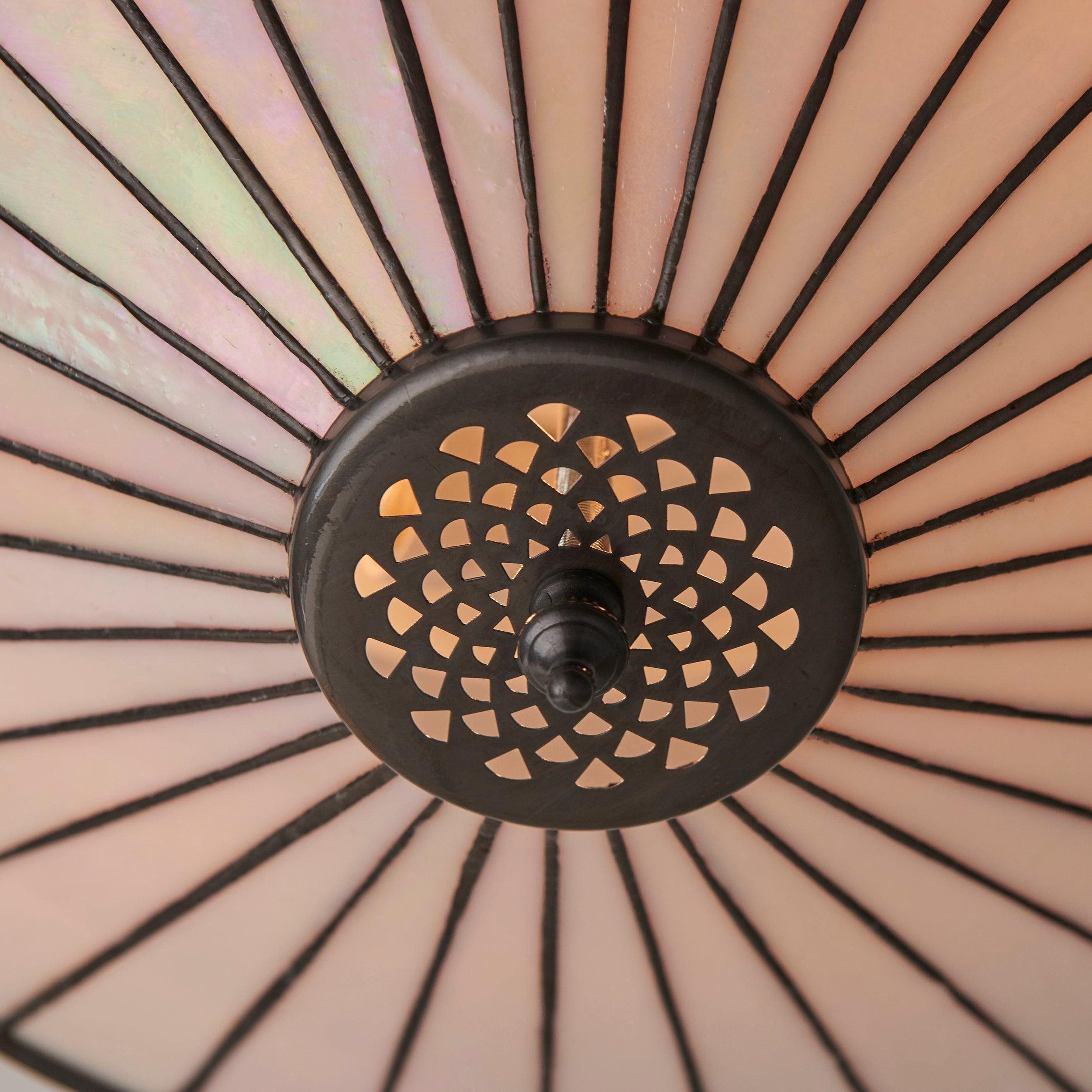
Tiffany lighting operates on an entirely different mechanical system than standard fabric shades. True Tiffany-style bases do not use standard ring fittings or shade carriers; they use a Harp and Finial or a Threaded Rod system.
The Tiffany Fitting System
A Tiffany lamp base typically features a short, threaded rod (usually 10mm in diameter) protruding from the top, high above the bulbs. The heavy stained-glass shade features a small hole at its peak. The shade drops down over this rod, and a decorative metal finial is screwed onto the top to lock the heavy glass securely in place.
-
Note on Adaptors: If you have a beautiful standard lamp base (with a normal B22 or E27 socket) and want to fit a Tiffany shade to it, you can! We sell Tiffany Harp Adaptors that attach to standard sockets and provide the threaded top rod required for stained glass shades.
Sizing Tiffany Shades
Because stained glass is heavier and visually denser than fabric, getting the proportions right is critical. The rules for Tiffany shades are slightly tighter than standard lamps:
-
Medium Table Lamps: We generally recommend a shade of around 40cm (16 inches) in diameter for a base that is approximately 55cm (21.5 inches) tall. A perfect example of this proportion is our iconic Blue Dragonfly Lamp.
-
Small Table Lamps: For smaller shades of 30cm (12 inches) diameter, a base of around 44cm (17 inches) is ideal. The Astoria table lamp uses these dimensions and is perfectly proportioned for bedside use.
-
Tiffany Floor Lamps: Stained glass floor lamps are magnificent pieces of art and require scale to make their intended statement. We strictly recommend a shade width of at least 50cm (20 inches) for any Tiffany floor base. Anything smaller will look like a "pinhead" on top of a tall pole.
Matching the Shade Shape to the Base Shape
Beyond size, the geometry of your lamp base should dictate the geometry of your shade. While breaking design rules can sometimes yield striking results, following the principle of "like matches like" guarantees a cohesive look.
| Base Shape | Ideal Shade Shape | Why it Works |
| Round / Urn / Spherical | Empire, Dome, Drum | The curved lines of the shade echo the curves of the base, creating fluid visual continuity. |
| Square / Rectangular | Square, Rectangular, Pagoda | Angular bases demand angular shades. A round shade on a sharp square base often looks mismatched. |
| Candlestick / Tall & Thin | Empire, Hexagonal, Small Drum | The flared bottom of an Empire shade provides visual weight to ground the skinny base. |
| Geometric / Art Deco | Stepped, Square, Tiffany geometric | Bold, architectural bases need shades with strong, defined structural lines. |
Final Styling Considerations: Material and Light Output
The size of the shade is only half the battle; the material determines how the lamp will actually function in your room.
For Ambient Lighting (Illuminating the Room):
If you want the lamp to light up the surrounding space, choose a translucent shade material. Light-colored silks, linens, and calico fabrics allow light to wash through the sides of the shade, creating a warm, general glow.
For Task or Mood Lighting (Directional Light):
If you want to use the lamp for reading, or to highlight a specific piece of furniture without flooding the room with light, choose an opaque shade. Dark-colored fabrics, thick velvets, metal shades, or shades with gold/silver foil linings force all the light strictly out of the top and bottom openings. This creates dramatic pools of light (perfect for cozy corners) but will not brighten the room as a whole.
The "Eye-Level" Test:
Finally, once you have chosen your shade and fitted it to your lamp, sit down next to it in the chair or bed you will use most often. Look at the lamp. If the shade is sized and positioned correctly, the bottom rim of the shade should be exactly at your eye level. This ensures you get maximum reading light without the glare of the naked bulb hitting your eyes.
Choosing a lampshade doesn't have to be guesswork. By measuring your base, applying the golden ratio of proportions, and selecting the correct fitting hardware, you can instantly refresh any lamp in your home with confidence.